
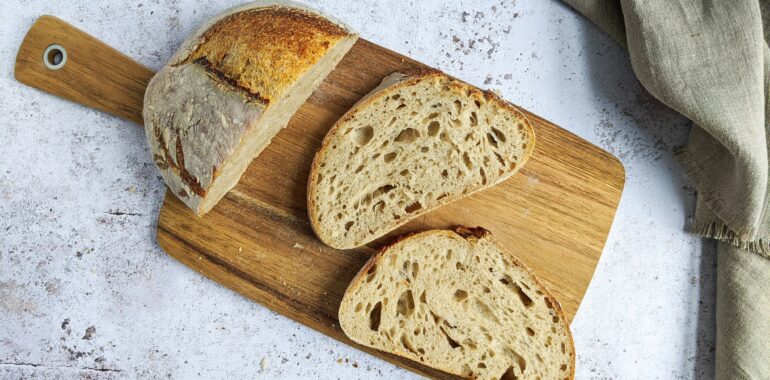
The Wild Yeast Revolution: Beginner-Friendly Sourdough Blueprints for Gut Health
For a long time, I viewed sourdough baking as a mysterious, high-stakes chemistry experiment—a daunting process involving scales, specialized “proofing” baskets, and a living starter that felt more like a demanding pet than a baking ingredient. Previously, I assumed that making “healthy” bread required complex gluten substitutes or that the traditional artisan loaf was too advanced for a home kitchen. It was easy to believe that bread was inherently “bad” for weight loss or that the bloating I felt after eating a store-bought sandwich was just the price of enjoying carbs. Everything changed when I looked into the “Lactic Acid Fermentation” process and the degradation of Phytic Acid. I discovered that real sourdough isn’t just bread; it’s a “pre-digested” superfood. When you stop relying on commercial yeast and start utilizing “Wild Fermentation,” you create a loaf that is lower in gluten, higher in bioavailable minerals, and remarkably gentle on the blood sugar.
The goal of the “Wild Yeast” protocol is to use time as your primary ingredient. I love the “low-friction” nature of these recipes. It’s the realization that while sourdough takes a long time to rise, the actual “work” time is less than fifteen minutes. When you swap the “rapid-rise” chemicals for a slow, 24-hour ferment, you’re supporting your gut microbiome and providing your body with a “Stable Energy” fuel source. These recipes are designed for the complete beginner—no fancy equipment required, just a bowl, a spoon, and a little bit of patience.
The Science of the “Sour”
Sourdough is biologically distinct from standard bread because of the symbiotic culture of bacteria and yeast (SCOBY) in the starter.
- Phytic Acid Neutralization: Grains contain phytic acid, an “anti-nutrient” that binds to minerals like magnesium and zinc, preventing absorption. The long fermentation of sourdough breaks this bond, making the bread a mineral-rich powerhouse.
- Gluten Breakdown: The lactobacilli in the starter partially digest the gluten proteins. This is why many people with mild gluten sensitivity find they can enjoy sourdough without the typical “Internal Inflate.”
- The “Slow-Burn” Carb: Sourdough has a significantly lower Glycemic Index (GI) than white or whole wheat bread. The organic acids produced during fermentation slow down the rate at which starch is converted to glucose.
The “No-Knead” Beginner’s Anchor
The ultimate starting point. No folding, no shaping—just stir and bake.
Ingredients:
- 1/2 cup Active Sourdough Starter
- 1 1/2 cups Warm Water
- 3 cups Bread Flour (Unbleached)
- 1 tsp Sea Salt
Instructions:
- The Mix: Stir everything in a bowl until a shaggy ball forms. Cover with a damp cloth.
- The Ferment: Let it sit on your counter for 8 to 12 hours (overnight is best).
- The Bake: Preheat a heavy pot (Dutch oven) to 230°C (450°F). Plop the dough in and bake covered for 30 minutes, then uncovered for 15.
Personal Tip: I call this “The Lazy Loaf.” If your schedule is packed, this is the one. The long room-temperature ferment does all the “kneading” for you by allowing the gluten strands to align naturally. It’s the highest “return on investment” in the baking world.
The “Mineral-Dense” Whole Grain Hybrid
Incorporating whole wheat for extra magnesium and a deeper “umami” profile.
Ingredients:
- 1/2 cup Starter
- 1 1/2 cups Water
- 2 cups White Bread Flour + 1 cup Whole Wheat Flour
- 1 Tbsp Honey (To feed the wild yeast)
Instructions:
- The Build: Mix the flours and water first, let sit for 30 minutes (this is called “Autolyse”), then add starter and honey.
- The Strength: Every 30 minutes for the first 2 hours, grab the edge of the dough and “stretch and fold” it over itself.
- The Bake: Same as the Anchor loaf. The whole wheat adds a nutty flavor that pairs perfectly with the “Savory-Sweet” Apple & Sage Chicken.
The “Gut-Soothing” Herb & Onion Focaccia
A flatbread style that focuses on “Psychobiotic” herbs and easy digestion.
Ingredients:
- 1/2 cup Starter
- 1 1/4 cups Water
- 3 cups Flour
- 2 Tbsp Olive Oil + 1 Tbsp Fresh Rosemary + 1 tsp Onion Powder
Instructions:
- The Spread: After the first ferment, pour the dough onto a rimmed baking sheet greased with olive oil.
- The Dimple: Use your fingers to poke deep holes in the dough. Drizzle with more oil and sprinkle with rosemary.
- The Bake: 20–25 minutes at 220°C (425°F).
The “Dark Cacao” Dessert Sourdough
A “Skin Recovery” treat that uses dark chocolate and fermentation to create a low-sugar indulgence.
Ingredients:
- 1/2 cup Starter
- 1 1/4 cups Water
- 2 1/2 cups Flour + 1/2 cup Dark Cacao Powder
- 1/2 cup Dark Chocolate Chips (70%+)
- 1/4 cup Maple Syrup
Instructions:
- The Blend: Mix the cacao into the flour before adding liquids.
- The Inclusion: Fold in the chocolate chips during the final “stretch and fold” session.
- The Result: A rich, sourdough-tangy bread that tastes like a brownie but has the “Stable Energy” profile of a fermented grain.
The “Sandwich Standard” (Soft Sourdough)
A tighter crumb perfect for toast or the “Mediterranean Power” Romaine Boats.
Ingredients:
- 1/2 cup Starter
- 1 cup Milk (Almond or Cow)
- 3 cups Flour
- 2 Tbsp Softened Ghee or Butter
Instructions:
- The Enrichment: The fats from the milk and ghee interfere with the gluten slightly, creating a much softer, “squishier” bread.
- The Shape: Place the dough in a greased loaf pan for its final rise.
- The Bake: 35–40 minutes at 190°C (375°F).
Maintaining Your “Bio-Engine”: The Starter Care
Your sourdough starter is a living colony of Lactobacillus and Saccharomyces. To keep it healthy:
- Feeding: Feed it equal parts flour and water once a week if kept in the fridge, or once a day if kept on the counter.
- The “Discard”: Don’t throw it away! Use your “discard” (the portion you remove before feeding) to make sourdough pancakes or crackers.
- The Temperature: Wild yeast loves a warm environment (21–24°C). If your kitchen is cold, your bread will take longer to rise, but it will actually develop a more complex “sour” flavor.
Reclaiming Your Daily Bread
Sourdough baking is a return to an ancient biological rhythm. By utilizing “Wild Fermentation,” you turn a simple staple into a tool for gut health, mineral absorption, and blood sugar stability. You’ll find that when you make your own bread, the “Brain Fog” and bloating associated with store-bought loaves disappear, replaced by the “Stable Energy” you need to conquer your day. This week, start your “No-Knead” Beginner’s Anchor—it’s the fastest way to realize that the best “supplement” for your health might just be a jar of flour and water sitting on your counter.
Final Tip: Always wait at least ONE HOUR before slicing into your bread! I know the smell is incredible, but the bread is still “cooking” and setting its internal structure while it cools. If you cut it too early, the steam escapes and the bread becomes “gummy.” Patience is the final step in the fermentation process!

I’m Brinley, and I believe in progress over perfection. My holistic journey started when I traded rigid fads for the 80/20 rule and nature-based remedies. I only share advice I’ve lived through—from botanical skincare that fixed my dry skin to easy kitchen hacks. I’m here to help you build a nourished life through small, intentional, and sustainable choices.