
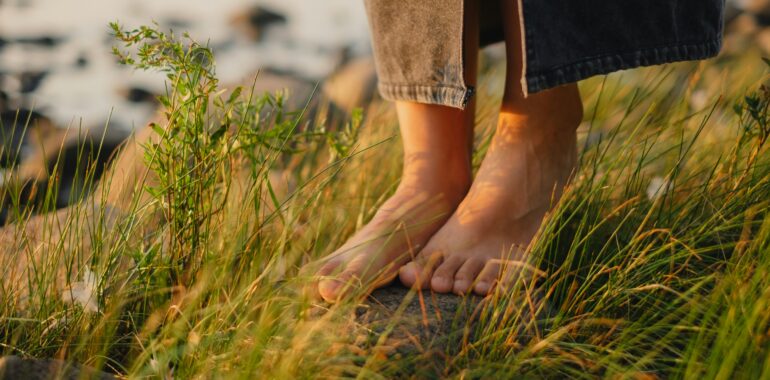
Barefoot Balance: The Benefits of Grounding While You Move
Growing up, I was the kid who always lost her shoes. Whether I was in the backyard or at the local park, I felt a magnetic pull to have my feet directly on the grass. I eventually moved away from this habit as I entered adulthood, convinced by fitness marketing that I needed thick, cushioned soles and high-tech “arch support” to move correctly. It wasn’t until I started experiencing persistent joint inflammation and a strange sense of “electrical” restlessness that I looked back toward the earth. I discovered that our bodies are essentially bioelectrical systems, and by insulating ourselves with rubber soles 24/7, we are effectively “ungrounding” our internal circuitry.
I’ve since learned that the earth carries a subtle, negative electrical charge. When you make direct skin contact with the ground—be it soil, sand, or grass—you absorb a flow of electrons that can neutralize free radicals in your body. I found that incorporating even fifteen minutes of “barefoot balance” into my daily routine didn’t just help my posture; it felt like a literal “reset” button for my nervous system. It is a free, natural, and incredibly powerful tool for anyone looking to reduce stress and improve their physical resilience.
This guide explores the science behind grounding, the biomechanical benefits of barefoot movement, and practical ways to safely reintroduce “earthing” into your modern life. It’s time to take off the sneakers and reconnect with the source.
The Science of the Earth’s Surface: Why Electrons Matter
To understand grounding, we have to think of the body as a conductor. Every day, through stress, pollution, and even the natural process of metabolism, our bodies build up a “positive” charge in the form of free radicals.
1. The Electron Transfer
The earth’s surface is a limitless reservoir of free electrons. When you stand barefoot, these electrons flow into your body, acting as natural antioxidants.
- The Benefit: Research published in the Journal of Environmental and Public Health suggests that this transfer can shift the autonomic nervous system from “fight or flight” (sympathetic) to “rest and digest” (parasympathetic).
Personal Tip: I like to do my “earthing” in the morning when the grass is still covered in dew. I’ve found that the moisture acts as a powerful conductor, significantly increasing the speed and efficiency of the electron transfer compared to standing on dry, parched soil.
2. Inflammation and Blood Viscosity
Grounding has been shown to improve “zeta potential,” which is essentially the electrical charge of your red blood cells.
- The Result: When your cells have a healthy charge, they repel each other rather than clumping together, which improves blood flow and reduces systemic inflammation.
Personal Tip: If I’m feeling particularly sore after a workout, I skip the anti-inflammatory pills and spend 20 minutes standing barefoot in my backyard. I’ve found that the “cool” energy of the earth seems to draw the heat and swelling out of my joints faster than an ice pack.
Biomechanical Balance: The Power of the “Bare Foot”
Beyond the electrical benefits, moving barefoot is a masterclass in functional anatomy. Your foot contains 26 bones, 33 joints, and over 100 muscles, tendons, and ligaments—most of which go dormant when locked inside a shoe.
1. Strengthening the Intrinsic Muscles
Modern shoes act like a “cast,” allowing the muscles in your feet to atrophy. When you walk barefoot, you engage the “intrinsic” muscles that support your arches and stabilize your ankles.
Personal Tip: I started by practicing “towel curls” with my bare feet on the grass. I’ve found that trying to scrunch up a towel using only my toes while standing on uneven ground helped me reclaim the “grip” and strength I had lost from years of wearing narrow sneakers.
2. Proprioception and Brain Health
Proprioception is your brain’s ability to perceive its position in space. The soles of your feet are packed with sensory nerves that send constant feedback to your brain about the terrain.
Personal Tip: I close my eyes for 60 seconds while standing barefoot on a textured surface like gravel or mulch. I’ve found that this “sensory challenge” forces my brain to calibrate my balance more accurately, which improved my overall posture and reduced my tendency to trip or stumble during the day.
How to Safely Incorporate Grounding Into Your Routine
You don’t need to hike a mountain barefoot to see results. The key is consistent, small exposures to the earth’s surface.
1. The “Fifteen-Minute Reset”
Aim for 15 minutes of direct contact. This can be standing, sitting with your feet on the grass, or even gardening with your bare hands.
Personal Tip: I combine my morning coffee ritual with my grounding time. I’ve found that by standing in the grass while I sip my tea, I create a “habit stack” that ensures I get my daily dose of electrons without feeling like I’m adding a chore to my schedule.
2. Choosing the Right Terrain
Not all “natural” surfaces are equal. Concrete and asphalt are insulators (they block the flow), while grass, sand, soil, and even brick (if it’s laid directly on the earth) are conductors.
Personal Tip: I love “beach earthing” the most. I’ve found that the combination of salt water and wet sand is the ultimate “super-conductor” for grounding. Whenever I’m near a coastline, I make it a point to walk in the “wash”—where the waves meet the sand—for maximum benefit.
3. The “Barefoot Shoe” Transition
If you aren’t ready to go completely barefoot in public, look into “minimalist” or barefoot-style shoes that have a wide toe box and a thin sole.
Personal Tip: I gradually transitioned to minimalist shoes over six months. I’ve found that if you switch too fast, your calves and Achilles tendons can get very tight. I started with just one hour a day of “thin-sole” walking until my body adjusted to the new mechanical load.
Overcoming the “Yuck” Factor: Grounding in the Modern World
One of the biggest hurdles to grounding is the concern about dirt or “germs.”
- The Reality: Healthy soil contains Mycobacterium vaccae, a “friendly” bacteria that has been shown to stimulate serotonin production and improve mood.
Personal Tip: I keep a “foot-washing station” by my back door—just a simple basin of warm water and a splash of apple cider vinegar. I’ve found that this ritualistic cleaning after my grounding session makes the experience feel like a spa treatment rather than a messy chore.
Grounding as a Form of Moving Meditation
In our hyper-digital world, we are constantly bombarded by Electromagnetic Fields ($EMFs$) from our devices. Grounding acts as a “shield” and a discharge for this accumulated static. It is a way to tell your body that it is safe, supported, and part of a larger, living system. When you move barefoot, you aren’t just exercising; you are participating in a multi-million-year-old biological relationship. You are balancing your energy, strengthening your foundation, and returning to a state of natural equilibrium.
Final Tip: If you live in a high-rise or an area where getting to grass is difficult, look into “grounding mats” or “grounding sheets” that plug into the third (ground) prong of your electrical outlet. I’ve found that while they aren’t quite as soul-nourishing as real grass, they are a fantastic way to maintain your electron balance during the winter months or when you’re stuck in the city.

I’m Brinley, and I believe in progress over perfection. My holistic journey started when I traded rigid fads for the 80/20 rule and nature-based remedies. I only share advice I’ve lived through—from botanical skincare that fixed my dry skin to easy kitchen hacks. I’m here to help you build a nourished life through small, intentional, and sustainable choices.