
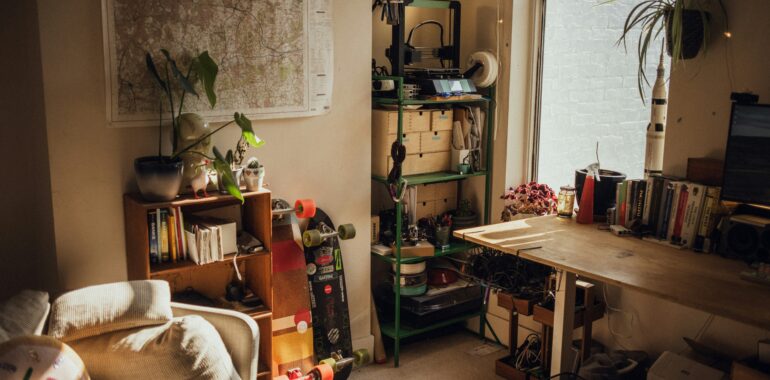
The Spatial Reset: How Purging Environmental Excess Restores Mental Clarity
There is a distinct, heavy weight that settles over your mind when you walk into a room filled with untamed stacks of paper, overflowing closets, and countertops buried under miscellaneous objects. For a long time, I treated a messy room as a minor character flaw—a visual annoyance that I would “get to” whenever I found a spare weekend. I spent years navigating my home while ignoring the low-grade anxiety that the physical clutter was inducing, falsely believing that my internal mental state was entirely separate from my external surroundings. I eventually reached a breaking point where I realized that my chaotic environment was directly mirroring, and accelerating, my chaotic thoughts.
The decision to treat decluttering as a fundamental health habit, rather than a seasonal chore, completely shifted my relationship with my home. Your living space acts as an external hard drive for your brain; when it is filled with broken fragments, unused items, and disorganized clutter, your cognitive load increases because your eyes have nowhere to rest. My experience has shown me that purging the excess isn’t just about creating an aesthetic that belongs on social media—it is an act of deep self-care that frees up mental energy, lowers stress levels, and restores a sense of agency to your life. If you are ready to quiet the visual noise and create a sanctuary for your mind, here is how to master the art of the spatial reset.
The Cortisol Connection: The Biology of Clutter
To understand why clearing a room feels so therapeutic, we have to look at what happens to your nervous system when you are surrounded by excess stuff. Human brains love order, predictability, and symmetry because these patterns signal to our evolutionary biology that an environment is safe.
The Stress of Excess: When your space is cluttered, your brain is bombarded with excessive stimuli. Every piece of junk mail, unworn pair of shoes, and unwashed dish acts as a silent “to-do” item that competes for your attention. Studies in behavioral psychology have shown that individuals living in cluttered homes show significantly higher levels of cortisol—the primary stress hormone—throughout the day compared to those who describe their homes as restful. By systematically removing the items that no longer serve a purpose, you are quite literally lowering the chemical markers of stress in your bloodstream. You are giving your nervous system permission to downshift out of “alert” mode.
Personal Tip: If you feel completely overwhelmed by the thought of tackling your whole house, don’t start with a giant closet or the entire garage. I’ve found that starting with a “Micro-Sanctuary”—like your bedside table or your primary workspace—is the best way to build momentum. Clear that single surface completely, wipe it down, and leave only what is essential. Having just one clean area to look at provides an immediate mental anchor of peace and proves to your brain how powerful a clear space can be.
The Three-Box Strategy: Introducing Functional Friction
The biggest hurdle to successful decluttering is the emotional attachment we form to inanimate objects. We hold onto things out of guilt, nostalgia, or the classic “what if I need this in five years?” anxiety. To break through this mental gridlock, you need a system that introduces logic back into the sorting process.
Instructions for the Sort: Whenever you tackle a drawer, a shelf, or a closet, bring three large boxes or bins with you. Label them clearly:
- Box 1: Keep & Home. This is for items that you actively use, love, and have a designated storage spot for.
- Box 2: Donate & Gift. This is for items that are in perfectly good condition but haven’t been used in the past year. Someone else can find joy in them.
- Box 3: The “Purgatory” Bin. This is the secret weapon for emotional decluttering. If you are deeply torn about an item, put it in this box.
Why this works: Once the Purgatory bin is full, tape it shut, write a date six months from now on the top, and put it in the garage or a closet out of sight. If you don’t look for or need anything inside that box for six months, you have physical proof that you can live without it. You can donate the box intact without opening it again, avoiding the secondary wave of guilt.
Personal Tip: When sorting through clothes, use the “Reverse Hanger” trick. Turn all the hangers in your closet so the hooks face backward (toward you). Every time you wear an item and wash it, hang it back up with the hook facing the normal way. At the end of six months, you will have an undeniable visual record of exactly what you actually wear and what is just taking up prime real estate in your closet. It completely eliminates the guesswork and the emotion from the purging process.
Maintenance as a Habit: The “One In, One Out” Rule
Decluttering is not a one-time event; it is a continuous lifestyle loop. The moment you clear a space, consumer culture will attempt to fill it again with new gadgets, clothes, and decorative items. To keep your home from reverting to a state of chaos, you have to build defensive habits at the door.
Instructions for Daily Preservation: Adopt the strict rule of “One In, One Out.” If you bring a new sweater into the house, an old sweater must go into the donation bin. If you buy a new kitchen tool, an old one must be rehomed. This creates an automatic checkpoint for your purchasing habits. It forces you to ask: “Is this new item worth losing something I already own?” It shifts your mindset from accumulation to curation, ensuring that your space stays balanced over time.
Personal Tip: I keep a permanent, stylish donation basket at the bottom of my closet. The moment I try on a piece of clothing and realize it doesn’t fit right, or that I feel uncomfortable in it, I don’t hang it back up. It goes directly into the basket. When the basket is full, I drop it off at a local charity center. This keeps the decluttering process integrated into my daily life, rather than letting it pile up into a massive, exhausting weekend project.
My Journey from Consumer to Curator
I remember a time a few years back when my desk was a graveyard of old sticky notes, tangled charging cables, and half-empty coffee mugs. I was trying to write a complex strategy report for work, but every time I looked down, my eyes darted from one piece of clutter to the next. I felt paralyzed, unable to form a coherent sentence. Out of pure frustration, I stood up, grabbed a trash bag, and cleared everything off the desk except my computer and a single notebook.
The relief was instantaneous. It felt like someone had opened a window in a stuffy room and let in a gust of fresh air. My thoughts cleared, my focus sharpened, and I finished the report in half the time I expected. That was the moment I realized that physical organization is directly tied to cognitive performance. Since then, I treat my evening “ten-minute tidy” with the same respect I treat brushing my teeth. It’s a habit that honors the morning version of myself, ensuring that I wake up to a clean slate and a calm mind rather than a baseline of chaos.
Honoring the Sanctuary of the Present
Cultivating the habit of decluttering is ultimately an exercise in editing your life so that only the things that add value remain. We have seen that by intentionally managing our physical environments, we can manipulate our biological stress responses, free up mental bandwidth, and create a space that breathes rather than suffocates.
As you look around your home today, stop seeing your items as permanent fixtures and start seeing them as energy conductors. Do they bring you joy, ease, and utility, or do they bring you guilt and stagnation? Take twenty minutes tonight to open a single drawer, grab your three boxes, and start the process of letting go. By pairing down the noise, you create room for the things that truly matter—peace, focus, and clarity. Your home should be the place you go to escape the chaos of the world, not the place where the chaos lives. Happy clearing!

I’m Brinley, and I believe in progress over perfection. My holistic journey started when I traded rigid fads for the 80/20 rule and nature-based remedies. I only share advice I’ve lived through—from botanical skincare that fixed my dry skin to easy kitchen hacks. I’m here to help you build a nourished life through small, intentional, and sustainable choices.