
The Fasting Fuel: What to Eat to Stay Full and Energized During Intermittent Fasting
Intermittent fasting has completely transformed the modern approach to health, weight loss, and metabolic efficiency. Millions of people have stepped away from the old routine of eating six small meals a day and embraced the simplicity of compressing their daily food intake into a specific window—whether that is a standard 16:8 split, a 20:4 routine, or an alternate-day framework.
The physiological benefits of fasting are undeniable: it stabilizes insulin levels, promotes cellular cleanup through autophagy, and turns your body into an efficient fat-burning machine.
But anyone who has actually tried intermittent fasting knows that the real battle isn’t happening inside your cells—it is happening inside your mind during the final hours of your fast. If you break your fast with a meal that leaves you starving two hours later, your fasting window tomorrow is going to feel like absolute torture.
To make intermittent fasting successful, sustainable, and entirely effortless, the secret lies in what you put into your body during your eating window. You need highly satiating, nutrient-dense meals that stabilize blood sugar and flip your internal fullness switches. Here is the science of fasting satiety, along with a complete menu of incredible, filling meals to fuel your window.
The Satiety Trifecta: Protein, Fiber, and Fats
When you operate on an intermittent fasting schedule, your meals cannot afford to be nutritionally empty. If your breaking-fast meal is loaded with simple carbohydrates or refined sugars, you trigger a massive blood sugar spike followed by a severe insulin crash. This crash is the exact mechanism that causes overwhelming cravings, brain fog, and low energy during your next fasting window.
To ensure all-day fullness, every single meal inside your eating window must be engineered around the Satiety Trifecta:
- Clean, High-Quality Protein: Protein handles the chemical side of fullness. Eating protein suppresses ghrelin (your body’s primary hunger hormone) while simultaneously increasing the production of peptide YY and GLP-1 (the hormones that tell your brain you are completely satisfied). It also has the highest thermic effect, meaning your body burns extra calories just digesting it.
- Complex, Viscous Fiber: Fiber handles the mechanical side of fullness. Soluble fiber absorbs water in your digestive tract, turning into a thick gel that slows down gastric emptying. Insoluble fiber adds physical volume to your meals, stretching the stomach wall to signal fullness to your brain without adding empty calories.
- Healthy, Nutrient-Dense Fats: Fats are your long-burning fuel log. While carbohydrates burn like quick paper flames, healthy fats (like avocados, nuts, seeds, and extra virgin olive oil) trigger the release of cholecystokinin (CCK), a hormone that slows down the digestive tract and provides a steady, multi-hour stream of background energy.
Meals to Fuel Your Intermittent Fasting Window
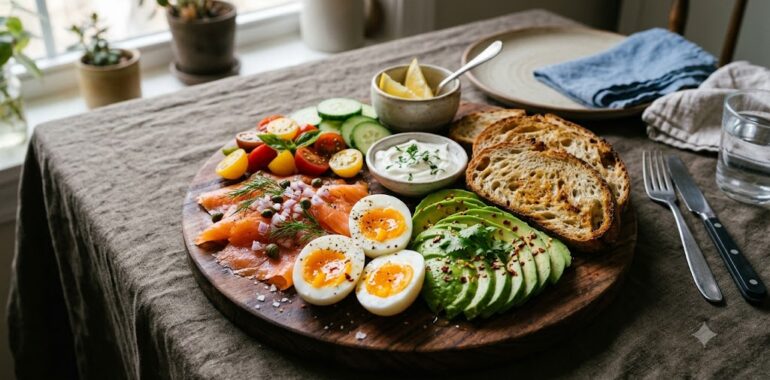
1. The Ultimate Fast-Breaker: The Avocado, Egg, and Smoked Salmon Platter
How you break your fast dictates your metabolic state for the rest of the day. This elegant, assembly-style breakfast platter provides a massive dose of clean proteins and healthy fats to gently awaken your digestive system without causing a sharp glucose spike.
Macronutrient Profile:
- Protein: 38 grams
- Dietary Fiber: 8 grams
- Healthy Fats: 26 grams
- Estimated Calories: 480
Ingredients:
- 2 large pasture-raised eggs (boiled, poached, or scrambled)
- 4 oz wild-caught smoked salmon
- 1/2 medium avocado, sliced thin
- 1 cup fresh baby spinach or arugula
- 1 tbsp pumpkin seeds (pepitas)
- 1 tbsp extra virgin olive oil
- A pinch of coarse sea salt and Everything Bagel seasoning
Instructions:
- Build the Greens Foundation: Arrange your fresh baby spinach or arugula across the bottom of a wide serving platter. Drizzle the greens with high-quality extra virgin olive oil.
- Arrange the Protectors: Place your sliced smoked salmon and cooked eggs symmetrically on top of the greens. Salmon provides high-quality omega-3 fatty acids that combat cellular inflammation, while whole eggs provide choline for cognitive focus.
- Add the Cream and Crunch: Nest the sliced avocado next to the eggs. Shower the entire platter with pumpkin seeds for a rich zinc boost and an addictive crunch, and finish with a dusting of Everything Bagel seasoning. Enjoy slowly with a large cup of black coffee or herbal tea.
2. The Mid-Window Anchor: The Southwest Turkey, Black Bean, and Quinoa Skillet
This high-volume, fiber-packed skillet is the perfect centerpiece meal. It combines the lean, muscle-building power of ground turkey with the slow-burning, complex carbohydrates of black beans and ancient quinoa, ensuring your glycogen stores are topped off sustainably.
Macronutrient Profile:
- Protein: 42 grams
- Dietary Fiber: 14 grams
- Complex Carbs: 32 grams
- Estimated Calories: 540
Ingredients:
- 1 lb lean ground turkey (93% lean)
- 1 can (15 oz) organic black beans, rinsed and drained
- 1 cup cooked quinoa
- 1 cup bell peppers, diced thin
- 1/2 yellow onion, chopped
- 1 cup fire-roasted crushed tomatoes (canned)
- 1 tbsp avocado oil
- 1 tsp ground cumin, 1 tsp chili powder, and 1/2 tsp garlic powder
- 2 tbsp plain Greek yogurt (used as a high-protein sour cream replacement)
Instructions:
- Sauté the Aromatics: Heat your avocado oil in a large, heavy-bottomed skillet over medium-high heat. Toss in the chopped yellow onion and diced bell peppers, cooking for 3 to 4 minutes until they begin to soften and brown.
- Brown the Protein: Add the ground turkey to the skillet, breaking it up thoroughly with a wooden spoon. Season with the cumin, chili powder, garlic powder, salt, and pepper. Cook for 6 to 7 minutes until no pink remains.
- Simmer the Base: Pour in the rinsed black beans, cooked quinoa, and fire-roasted crushed tomatoes. Stir the ingredients together until completely uniform. Turn the heat down to medium-low, cover with a lid, and let it simmer for 5 minutes to allow the quinoa and beans to soak up the savory tomato juices.
- Plate and Garnish: Scoop a generous portion into a bowl, and finish with a dollop of plain Greek yogurt for an extra hit of clean protein and cooling creaminess.
3. The Fast-Closing Anchor: The Mediterranean Macadamia Salmon Bed
Your final meal before entering your next fasting window needs to act like a slow-release time capsule of nutrition. This rich, luxurious dinner leverages the long-burning properties of macadamia nut fats and salmon protein to keep your hunger completely quiet through the night and into the following morning.
Macronutrient Profile:
- Protein: 44 grams
- Dietary Fiber: 7 grams
- Healthy Fats: 32 grams
- Estimated Calories: 610
Ingredients:
- 1 large center-cut salmon fillet (approx. 6-7 oz)
- 2 tbsp raw macadamia nuts, finely chopped
- 1 tbsp Dijon mustard (used as a binder for the nuts)
- 2 cups broccoli florets
- 1 cup sliced zucchini rounds
- 1 tbsp extra virgin olive oil
- Lemon wedges for serving
Instructions:
- Prep the Oven: Preheat your oven to 400 degrees Fahrenheit (200 degrees Celsius) and line a large baking sheet with parchment paper.
- Crust the Seafood: Pat your salmon fillet completely dry with a paper towel. Brush the top surface with a thin layer of Dijon mustard, then press the finely chopped macadamia nuts firmly into the mustard to create a textured crust. Season with a tiny pinch of salt.
- Roast the Greens: Toss your broccoli florets and zucchini slices in the extra virgin olive oil, salt, and pepper. Arrange the vegetables on one side of the baking sheet, and place the crusted salmon on the other side.
- Bake: Slide the sheet into the oven and bake for 12 to 14 minutes. The macadamia nuts will toast into a beautiful golden brown crust, and the salmon will be perfectly tender and flaky. Serve with a heavy squeeze of fresh lemon juice across the fish and roasted greens.
The Golden Rule of Fasting Success: Hydrate Intentionally
As you transition into your next fasting window after your final meal, remember that hunger is frequently just dehydration in disguise. When your insulin levels drop during a fast, your body naturally flushes out excess water weight along with essential electrolytes like sodium, magnesium, and potassium.
Make sure you are drinking plenty of clean, filtered water throughout your fasting window. If you experience a sudden wave of hunger or a slight headache, try adding a tiny pinch of high-quality sea salt or a zero-calorie, unflavored electrolyte powder to your water bottle. This immediately rebalances your cellular hydration, suppresses false hunger cues, and keeps your energy soaring cleanly until your next eating window opens.

I’m Brinley, and I believe in progress over perfection. My holistic journey started when I traded rigid fads for the 80/20 rule and nature-based remedies. I only share advice I’ve lived through—from botanical skincare that fixed my dry skin to easy kitchen hacks. I’m here to help you build a nourished life through small, intentional, and sustainable choices.