
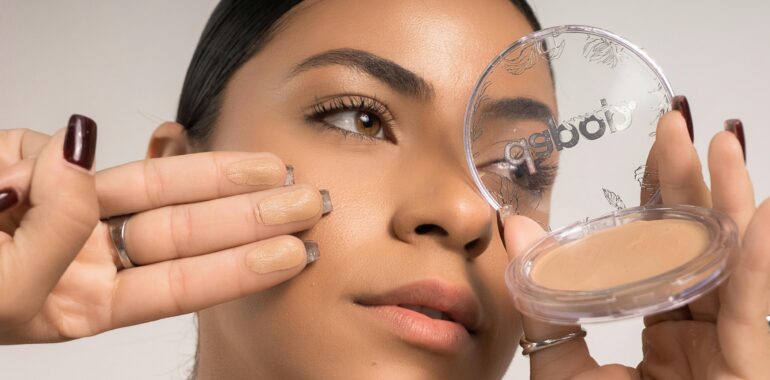
The Invisible Veil: Decoding Your True Skin Undertone for a Flawless Match
In my earlier days of makeup exploration, I viewed foundation as a simple exercise in choosing the right “depth”—a matter of picking a bottle that looked roughly as light or dark as my face. Previously, I assumed that if a shade didn’t look right, I just hadn’t found the exact “beige” or “tan” that matched my tan level. It was easy to believe that foundation was a one-dimensional product. Everything changed when I looked into the “Chromatic Depth” of the dermis and the science of color theory. I discovered that your skin tone (the surface color) and your undertone (the subtle hue beneath the surface) are two entirely different biological realities. When you ignore your undertone, even the “right” shade of foundation will look ashy, orange, or ghostly. By mastering the art of the undertone, you stop trying to “paint” over your skin and start using a formula that disappears into your complexion, revealing a seamless, “second-skin” finish.
The goal of finding your true undertone is to move from “close enough” to “invisible.” I love the “precision” of this cosmetic shift. It’s the realization that while your tan may change with the seasons, your undertone is a permanent genetic blueprint. When you swap the guesswork for targeted tests like the “Vein Check” or the “White Paper Contrast,” you’re supporting your skin’s natural beauty instead of fighting it. These strategies are designed to help you navigate the confusing aisles of the beauty world with the confidence of a professional makeup artist.
The Science of the “Subsurface”: Tone vs. Undertone
To find your perfect match, you must first distinguish between the two layers of color your skin presents:
- Surface Tone: This is what you see in a quick mirror check—Fair, Light, Medium, Tan, or Deep. It is determined by the concentration of Melanin in your epidermis and can change based on sun exposure or “Skin Recovery Cycles.”
- Undertone: This is the muted, subtle color just below the surface. It is influenced by the blood vessels (veins and capillaries) and the thickness of your skin layers. Unlike your surface tone, your undertone remains constant for life.
The “Triple Threat” Tests for Accuracy
Since the undertone is “hidden,” we must use specific light-physics tests to coax it out. Do these in natural daylight for the most accurate results.
1. The “Vein Check” (Vascular Mapping)
Look at the veins on the inside of your wrist. They act as a translucent filter for your undertone.
- Cool: Your veins appear blue or purple.
- Warm: Your veins appear greenish or olive (the yellow of your skin + the blue of the vein = green).
- Neutral: You can’t quite tell, or they look like a mix of blue and green.
2. The “White Paper” Contrast Test
Hold a piece of stark white copy paper next to your clean, naked face in front of a mirror.
- Cool: Your face appears pink or rosy against the white.
- Warm: Your face appears yellowish, peachy, or golden beside the paper.
- Neutral: Your skin looks grey or simply “balanced” without a distinct lean toward yellow or pink.
3. The “Sun Reaction” History
Think back to your last “Wild Cardio” session or a day at the beach.
- Cool: You burn easily and rarely tan, or you turn a “strawberry” pink before anything else.
- Warm: You tan easily and rarely burn, turning a golden-brown or bronze hue.
- Neutral: You might burn first and then tan, or you tan without much effort but don’t get as “golden” as a warm-toned person.
The Spectrum: Understanding the “Big Four”
Once you’ve run the tests, you’ll likely fall into one of four biological categories that dictate your best foundation labels. Those with Cool undertones feature pink, red, or blue hues and should look for labels like “Cool,” “Rose,” or “C.” Warm individuals possess yellow, gold, or peach hues and match best with “Warm,” “Golden,” or “W.” Neutral types have a balanced mix and should seek “Neutral” or “N” labels.
Finally, those with Olive undertones have a unique mix of green, grey, and ashen hues. These are often the hardest to match; if “Warm” foundations look too orange and “Cool” foundations look too pink, you are likely in the Olive family and should seek “Olive” or “muted” shades. Understanding these distinctions ensures you aren’t just wearing a mask, but rather a shade that honors your specific genetic hue.
The “Perfect Match” Habit: The Jawline Swatch
Never test foundation on your wrist! The skin on your arms is usually darker and has a different texture than your face.
- The Rule: Swatch three shades (one you think is the match, one shade lighter, and one shade darker) in vertical stripes from your jawline down to your neck.
- The Logic: Your face often has surface redness (from acne or tretinoin) that can “lie” about your undertone. Your neck is your true canvas. The shade that “vanishes” across both the jaw and the neck is your winner.
- The Oxidation Wait: Wait 15 minutes! Some formulas “oxidize” (turn darker or more orange) once they hit the air. If it still looks invisible after the 15-minute mark, it’s the one.
Personal Tip: I used to buy “Warm” foundations because I have a bit of surface redness and thought I needed to “warm up” my face. I ended up looking like an Oompa-Loompa in every photo. Once I realized I was actually a “Light-Medium Neutral-Olive,” I switched to a muted, greyish-beige foundation. Suddenly, I didn’t need as much concealer because the color was doing the work for me! If you struggle with redness, don’t try to “fix” it with a warm foundation—match your neck instead.
Beyond the Bottle: Clothing and Jewelry Clues
If you’re still on the fence, look at your “Golden Hour” wardrobe:
- Cool: You look most radiant in silver, platinum, and “jewel” tones like emerald or sapphire. Bright white clothes make you pop.
- Warm: You shine in gold jewelry and earthy tones like mustard, olive green, and terracotta. Off-white or cream looks better on you than stark white.
- Neutral: You’re a “chromatic chameleon.” Both gold and silver look great, and you can rock almost any color on the wheel.
Honoring Your Genetic Hue
Finding your true skin undertone is a “cosmetic liberation.” It takes the stress out of shopping and ensures that your makeup is always an enhancement, never a mask. By respecting the subtle “Subsurface” colors of your biology, you allow your “Glow & Grow” habits to shine through. This week, try the “White Paper” test. You might discover that the “ashy” foundation you’ve been fighting is simply a mismatch of the beautiful, complex hues hiding just beneath your surface.
Final Tip: Always check your match in three different lighting sources: natural sunlight, fluorescent “office” light, and warm “home” light. If it looks good in all three, you’ve found the “holy grail” of matches!

I’m Brinley, and I believe in progress over perfection. My holistic journey started when I traded rigid fads for the 80/20 rule and nature-based remedies. I only share advice I’ve lived through—from botanical skincare that fixed my dry skin to easy kitchen hacks. I’m here to help you build a nourished life through small, intentional, and sustainable choices.