
The “Main Character” Veggie: Dinners That Prove Vegetables Aren’t Just a Side Dish
I viewed “Vegetable-Forward” dinners as a side-dish struggle—a collection of steamed broccoli or limp carrots that served as a bland obligation alongside a “real” main course. Previously, I assumed that to feel truly satisfied, a meal had to be anchored by a massive portion of animal protein, otherwise, I’d be left with a nagging “metabolic itch” an hour later. It was easy to believe that vegetables were just “filler” rather than the main event. Everything changed when I looked into the “Phytochemical Density” and the “Umami-Anchoring” potential of plant-based fats and fibers. I discovered that when you treat a vegetable with the same “Maillard-Reaction” respect you give a steak—searing, roasting, and glazing—you unlock a level of satiety that rivals any traditional meal. When you stop “boiling for health” and start “roasting for flavor,” you provide your body with a massive dose of micronutrients that support your “Internal Steam-Clean” without the digestive weight.
The goal of the “Botanical Baseline” protocol is to use seasonal produce as the structural foundation of your evening, rather than an afterthought. I love the “anti-inflammatory” efficiency of this approach. It’s the realization that you can eat a high-volume, “Indulgent-feeling” dinner that actually lowers your “Internal Inflate.” When you swap the heavy starches for “Densed-Grained” vegetable bases and “Healthy-Fat” dressings, you’re supporting your “Adrenal-Calm” balance and ensuring your “Brain Fog” stays at bay. These recipes are designed to be “Fresh & Functional”—maximizing the nutrient-to-calorie ratio while keeping the flavor profiles high.
The Science of the “Phyto-Flush”
Why does a vegetable-forward dinner change your “Neural Firing” speed? It’s all about the “Fiber-Microbiome” axis.
- The Diversity Signal: Your gut microbiome thrives on variety. Each different colored vegetable provides a specific “Polyphenol Signal” that feeds beneficial bacteria. A diverse gut is the primary driver of “Stable Energy” and immune resilience.
- Volume vs. Density: Vegetables allow for “Volume Eating.” You can physically fill your stomach (triggering the vagus nerve) with a massive bowl of roasted cauliflower for a fraction of the metabolic cost of a pasta bowl.
- The “Antioxidant” Buffer: High-heat cooking can create oxidative stress. However, when you cook vegetables, you release “Bound Antioxidants” (like the lycopene in tomatoes or the beta-carotene in carrots), which act as an internal shield for your cells.
The “Umami-Anchor” Cauliflower Steaks
Ingredients:
- 1 large head of Cauliflower (sliced into 1-inch “steaks”)
- 2 Tbsp Extra Virgin Olive Oil
- 1 tsp Smoked Paprika + 1/2 tsp Cumin
- 1/4 cup Toasted Pine Nuts (for the “Protein-Crunch”)
Instructions:
- The Sear: Brush the cauliflower with oil and spices. Sear in a hot skillet for 2 minutes per side to get that “Caramelized Reset.”
- The Roast: Move to the oven at 200°C (400°F) for 15 minutes.
- The Logic: The caramelization provides the “Umami” flavor that triggers satiety.
Personal Tip: I serve this with a dollop of Greek yogurt mixed with lemon. The acidity of the lemon and the fat of the yogurt “anchors” the earthy flavor of the cauliflower, making it feel like a gourmet main course.
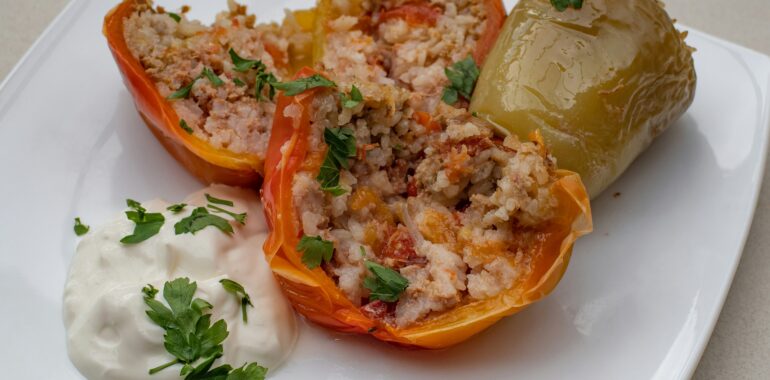
The “Structure-Build” Stuffed Bell Peppers
Ingredients:
- 3 large Bell Peppers (Halved)
- 1 cup Cooked Quinoa (The “Fiber-Base”)
- 1 cup Black Beans
- 1/2 cup Walnuts, crushed (for texture)
- 1 cup Marinara (No sugar added)
Instructions:
- The Mix: Combine quinoa, beans, walnuts, and sauce in a bowl.
- The Fill: Stuff the mixture into the pepper halves.
- The Bake: Roast at 190°C (375°F) for 25 minutes until the peppers are tender.
Personal Tip: The walnuts are the “Invisible Upgrade” here. They provide a “meaty” texture and a dose of Omega-3s that support your “Neural Performance” while you digest.
The “Rainbow-Recovery” Sheet Pan Roast
Ingredients:
- 2 cups Brussels Sprouts (Halved)
- 2 large Carrots (Sliced into coins)
- 1 Red Onion (Wedged)
- 1 cup Chickpeas (Drained and patted dry)
- 1 Tbsp Avocado Oil + 1 Tbsp Balsamic Glaze
Instructions:
- The Toss: Coat all the vegetables and chickpeas in the oil and sea salt.
- The Roast: Spread in a single layer and roast at 210°C (415°F) for 25 minutes.
- The Glaze: Drizzle with balsamic glaze in the last 2 minutes for a “Sweet-Acid” finish.
Personal Tip: The chickpeas get incredibly crunchy when roasted this way. They act as your “Protein-Anchor” and provide that essential “mechanical crunch” that tells your brain the meal is substantial.
The “Deep-Tissue” Mushroom & Spinach Sauté
Ingredients:
- 3 cups Portobello or Shiitake Mushrooms (Sliced)
- 4 cups Fresh Spinach
- 2 cloves Garlic (Slivered)
- 1 Tbsp Coconut Aminos (The “Soy-Alternative”)
- 1/2 Avocado (Sliced on top)
Instructions:
- The Sauté: Cook the mushrooms in a dry pan first to release moisture, then add a splash of oil and the garlic.
- The Wilt: Toss in the spinach and coconut aminos until the greens just barely collapse.
- The Anchor: Top with avocado for those “Healthy-Fats.”
Personal Tip: Mushrooms contain “Ergothioneine,” a unique antioxidant that protects your mitochondria. I call this my “Cellular Cleaning” dinner because it feels light but is incredibly nutrient-dense.
The “Internal-Flow” Warm Cabbage Slaw
Ingredients:
- 4 cups Shredded Cabbage (Red and Green)
- 1 Apple (Thinly sliced)
- 1 Tbsp Apple Cider Vinegar + 1 Tbsp Dijon Mustard
- 1/4 cup Sunflower Seeds
Instructions:
- The Sauté: Quickly toss the cabbage and apple in a pan with a splash of water for 3 minutes. You want it warm but still “crunchy.”
- The Sauce: Whisk the ACV and mustard and pour over the warm slaw.
- The Crunch: Top with sunflower seeds for a “Mineral-Boost.”
Personal Tip: Warm cabbage is significantly easier to digest than raw cabbage. If you struggle with “The Bloat” after eating veggies, this “Quick-Sauté” method is the perfect “Digestive Bridge.”
The “Botanical” Guardrails
- The “Fat-Anchor” Rule: Vegetables require fat for the absorption of fat-soluble vitamins (A, D, E, and K). Never eat a “Dry” vegetable dinner. Always add a splash of olive oil, a handful of nuts, or a slice of avocado to ensure you’re actually absorbing the nutrients.
- The “Maillard” Priority: Don’t crowd the pan! If you want your vegetables to taste “meaty” and satisfying, they need space to roast. If they are too close together, they will steam instead of brown, and you’ll lose that essential “Umami-Anchor.”
- The “Variety” Check: Aim for three different colors on your plate. Each color represents a different “Phytochemical Class.” The more colors you eat, the more “Biological Information” you are giving your cells.
Mastering the Plant-Based Pivot
Vegetable-forward dinners are not a sacrifice; they are a “System Upgrade.” By prioritizing “Maillard-Reaction” roasting and “Healthy-Fat” anchoring, you move from a state of “Digestive Heaviness” to a state of “Functional Vibrancy.” You’ll find that when your evening is built on a foundation of botanical fibers, your “Brain Fog” clears and your energy returns to a steady, sharp baseline the next morning. This week, try the “Umami-Anchor” Cauliflower Steaks—it’s the fastest way to realize that your “Lightest” meal can be your most satisfying one.
Final Tip: Keep a “Flavor-Station” on your counter. A good sea salt, a bottle of high-quality ACV, and a jar of toasted seeds can turn any “plain” vegetable into a “Performance-Meal” in seconds!

I’m Brinley, and I believe in progress over perfection. My holistic journey started when I traded rigid fads for the 80/20 rule and nature-based remedies. I only share advice I’ve lived through—from botanical skincare that fixed my dry skin to easy kitchen hacks. I’m here to help you build a nourished life through small, intentional, and sustainable choices.